Giuseppe David · teacher and designer

My work in
electronics and teaching.

Bytefullness is where I bring together my projects in electronics, software and automation. I’m Giuseppe David, a teacher and designer, interested in how the things I build can become practical ways to learn.

Here I describe some of that work, from aquaponics to educational robotics: the questions behind each project, how I approach them and what I am still developing.

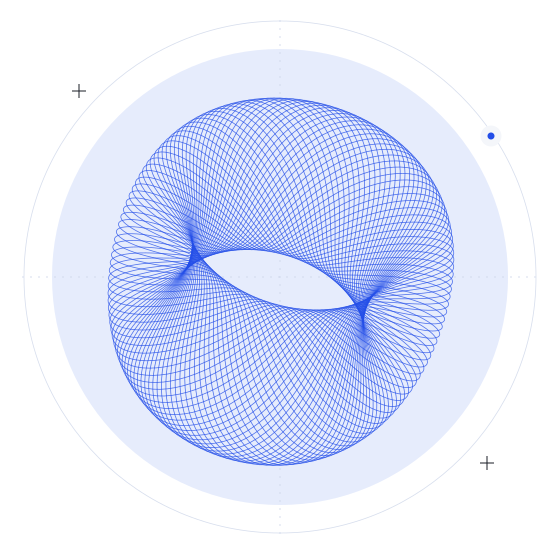
A visual experiment
Shapes drawn with code

The lines wrap around an open centre.

The person behind Bytefullness

Giuseppe David

Teacher, designer
and experimenter

Why I bring together
design and teaching

As a teacher, I want an explanation to be something people can test. A sensor, an electronic board or a small robot makes it possible to see what happens when a connection or an instruction changes. I try to bring that way of thinking into my design work too.

When developing a device, I also think about the person who will need to understand and use it. The software, interface and instructions are all part of the same task. A technical choice needs to be explained clearly enough for someone to discuss it, check it and, where needed, change it.

Bytefullness grew out of this interest. It gives me a place to connect different experiences and describe work while it is still taking shape, including solutions that need testing and questions I have yet to answer.
01 / The approach

How I take an idea
through to a practical test

Each project calls for different tools. I try to keep the process clear enough to retrace, so I can explain why I made a choice and what evidence supports it.

01

Understand the problem

I start with the intended use: who will use the tool, in what setting and with which resources. Before choosing a board or writing code, I work out what should happen and how I will be able to tell whether the system behaves as expected.

02

Build and check

I develop an initial version and test its parts. When something does not work, I compare the expected behaviour with what I observe, then revise the circuit or the code. I keep software checks separate from tests on the physical device because they answer different questions.

03

Explain the process

I document the configuration steps, test conditions and limitations I find. In teaching, these notes help others reconstruct the reasoning. Someone continuing the work should be able to understand what they can change and what they need to check afterwards.

02 / Projects and paths

Three areas
of my work

Aquaponics, DIYLOGIC and ECOBOT-3 address different problems. Together, they show how my interest in controlling systems connects with building tools and teaching.

01 / BYTEFULLNESS

Living systems

Aquaponics
and control

My experience with aquaponic systems led me to work on process control, data collection and automation. That work developed into tools and projects such as DIYLOGIC and ECOBOT-3.

In this setting, a sensor reading becomes meaningful when it is connected to what is happening in the system. That is the part that interests me: deciding what to observe, interpreting the data and understanding which actions need to be controlled.

Technology and progress
Field
Project experience
Technologies
Data · sensors · automation
Work status
Control method and basis for later tools.
02 / BYTEFULLNESS

Tools and autonomy

DIYLOGIC

With DIYLOGIC, I work on software tools for local automation using compatible ESP32 boards. The firmware — the program running on the board — manages the device’s functions, while a browser interface lets the user configure them.

Installation and the instructions that accompany it are also part of the work. The aim is to make the process understandable, from preparing the board and choosing settings to checking the resulting behaviour.

Technology and progress
Field
Applied research
Technologies
ESP32 · firmware · web interface
Work status
Firmware, interfaces and installation procedures under development and testing.
03 / BYTEFULLNESS

Educational robotics

ECOBOT-3

ECOBOT-3 is a small ESP8266 vehicle developed through Robotica Creativa. The project includes the robot’s firmware, an Android app to prepare the board and drive the vehicle, and a browser interface reached through the robot’s own Wi-Fi network.

In a teaching activity, this makes it possible to connect an instruction with the movement it produces. Learners can form a hypothesis, change the code or the wiring, and observe the result. The project website contains guides and technical documentation.

Technology and progress
Field
Educational experimentation
Technologies
ESP8266 · firmware · Android
Work status
Documented firmware and app. Software tests remain distinct from physical prototype commissioning.
Read the ECOBOT-3 guides

03 / The tools

What
I work on

My projects connect the device, its software and the people who will use it. These are the areas I focus on.

  1. 01

    Electronics and firmware

    I work with boards and sensors, and with the code that defines their behaviour. This includes communication between components and the checks needed to understand whether the device responds as expected.

  2. 02

    Automation and data

    I study how to read signals from a system and use them to define actions and control rules. Measurements and observations over time help establish when a rule works and when it needs to change.

  3. 03

    Interfaces and documentation

    I design screens and write instructions to guide people through using the tools. I try to make each step and available choice clear, including how to recognise a problem during configuration.

  4. 04

    Robotics and prototyping

    I use prototypes as a way to explore mechanics, electronics and programming together. In teaching, the result of a test becomes a starting point for the next explanation.

Contact

Tell me
what you’re working on.

If you are planning a teaching activity, developing a prototype or working through a technical problem, you are welcome to write to me.

Describe the context, what you want to achieve and what you have tried so far. This will help me understand your idea and consider how we might work on it together.